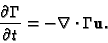
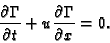
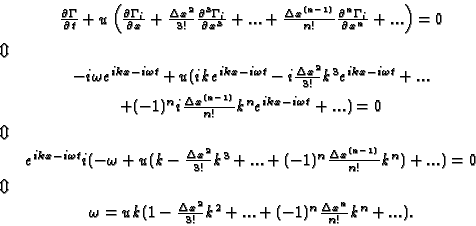
Now, to make the analysis easier we initially consider the one dimensional case
with constant velocity u,
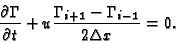
As we have noted earlier, this discretisation implies losing some higher-order
terms. To see why this happens we will express the above approximation by the
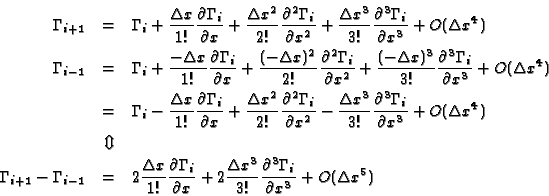
Taylor expansion of the terms involved, as we approximate
 and
and
 by respectively expanding forward and backward from the value
 by the distance
 between any two grid nodes:
Consequences and Interpretation
To give an impression of what this means for the solution, we now let
 represent
a simple sinusoidal wave in time and space. We then isolate the temporal
frequency and calculate the wave speed, from which we can gain some insight
into how the system evolves. The wave can be described as
represent
a simple sinusoidal wave in time and space. We then isolate the temporal
frequency and calculate the wave speed, from which we can gain some insight
into how the system evolves. The wave can be described as
 which
enables us to extend the argument, at least to periodic solutions as we
simply approximate the shape through Fourier series. By simple insertion we
find
which
enables us to extend the argument, at least to periodic solutions as we
simply approximate the shape through Fourier series. By simple insertion we
find
With spatial wave length

and time frequency

we
find the wave speed
which converges as the faculty operator is stronger than the power. We see
that the speed at which a solution propagates is dependent on the spatial
frequency, and that the most significant term enters with a negative
coefficient, causing a slow down of frequencies. At constant grid spacing
,
and as a low value of
k models a high spatial frequency wave, we can
now see high frequency modes will move slower than low frequency ones. This
means that over time a solution consisting of a broad range of frequencies
will change shape, as high mode frequencies will be left behind. This is
especially evident in the solution of the square wave, which has
non-vanishing amplitude in all frequency modes, and hence all terms in the
Taylor expansion are of importance. This is the origin of the dispersion
phenomena mentioned in an earlier section. In our case this is especially
worrying, as we have already seen, shocks may evolve naturally in the
system, and hence the near discontinuities in the shock fronts result in
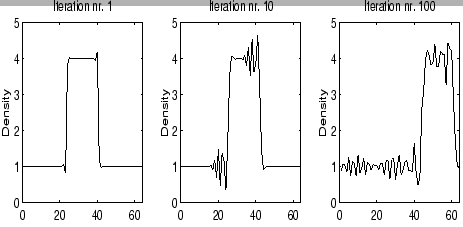
high order frequencies dominating the system. This can be seen in figure
3.5
Figure 3.5: Constant velocity propagation
of a steep wave using a naive implementation of the difference
operator.
|
, where we see how such a system evolves. We see that the truncation results
in dispersion as high frequency modes are left behind by the bulk of the
wave causing numerical instability due to the steep gradients flooding the
solution. At roughly iteration number 130 the valley immediately following
the hill became negative, crashing the simulation. As a rule of thumb
truncation is of no immediate concern if the shock is resolved on the grid,
i.e. the wave length of the highest mode frequency in the shock is a number
of times longer than the grid spacing
,
as is also hinted by the term

entering under the power operator.
Another view at the problem is noticing that in the difference operation
of order n we truncated
terms from the Taylor series from the order
n and up, terms for which
the coefficients

was in some sense small, under the assumption that the differential operator

is
in some sense limited, making all the truncated terms insignificant for the
solution. But at near discontinuities this is
not the case, as
becomes
of significance, breaking the assumption and infecting the solution.
The net result is that the truncation error will be of relevance in shock
regions, and that we cannot approximate the solution correctly in an extreme
shock-region, no matter the order of the difference operator. If ignored
this will in many cases cause the discrete approximations to explode, and in
return drown the correct solution in numerical noise.
But what if we could avoid the discontinuities altogether?