OneStopGate.Com
OnestopGate   OnestopGate

  JOIN GATE GROUP, Looking for GATE Preparation Materials? Join & Get GATE Preparation Materials now!, JOIN GATE GROUP
OnestopGate
Home | Overview | Syllabus | Tutorials | FAQs | Downloads | Advertise | Contact Us | Forum
OneStopGate

GATE Overview
  arrow to indicate  Overview
  arrow to indicate  GATE Eligibility
  arrow to indicate  Structure Of GATE
  arrow to indicate  GATE Coaching       Centers
  arrow to indicate  Colleges Providing M.Tech/M.E.
  arrow to indicate  GATE Score
  arrow to indicate  GATE Results
  arrow to indicate  PG with Scholarships
  arrow to indicate  Article On GATE
  arrow to indicate  GATE Forum

GATE 2009 Exclusive
  arrow to indicate  GATE 2009 Syllabus
  arrow to indicate  GATE Organizing Institute
  arrow to indicate  Important Dates
  arrow to indicate  How to Apply
  arrow to indicate  Discipline Codes

GATE Syllabus
  arrow to indicate  Aerospace Engg..
  arrow to indicate  Agricultural Engg..
  arrow to indicate  Architecture and Planning
  arrow to indicate  Chemical Engg..
  arrow to indicate  Chemistry
  arrow to indicate  Civil Engg..
  arrow to indicate  Computer Science / IT
  arrow to indicate  Electronics & Communication Engg..
  arrow to indicate  Electrical Engg..
  arrow to indicate  Engineering Sciences
  arrow to indicate  Geology and Geophysics
  arrow to indicate  Instrumentation Engineering
  arrow to indicate  Life Sciences
  arrow to indicate  Mathematics
  arrow to indicate  Mechanical Engg..
  arrow to indicate  Metallurgical Engg..
  arrow to indicate  Mining Engg..
  arrow to indicate  Physics
  arrow to indicate  Production & Industrial Engg..
  arrow to indicate  Pharmaceutical Sciences
  arrow to indicate  Textile Engineering and Fibre Science

GATE Study Material
  arrow to indicate  Aerospace Engg..
  arrow to indicate  Agricultural Engg..
  arrow to indicate  Chemical Engg..
  arrow to indicate  Chemistry
  arrow to indicate  Civil Engg..
  arrow to indicate  Computer Science /       IT
  arrow to indicate  Electronics &       Communication Engg..
  arrow to indicate  Electrical Engg..
  arrow to indicate  Engineering Sciences
  arrow to indicate  Instrumentation       Engg..
  arrow to indicate  Life Sciences
  arrow to indicate  Mathematics
  arrow to indicate  Mechanical Engg..
  arrow to indicate  Physics
  arrow to indicate  Pharmaceutical       Sciences
  arrow to indicate  Textile Engineering        and Fibre Science

GATE Preparation
  arrow to indicate  GATE Pattern
  arrow to indicate  GATE Tips N Tricks
  arrow to indicate  Compare Evaluation
  arrow to indicate  Sample Papers
  arrow to indicate  GATE Downloads
  arrow to indicate  Experts View

CEED 2009
  arrow to indicate  CEED Exams
  arrow to indicate  Eligibility
  arrow to indicate  Application Forms
  arrow to indicate  Important Dates
  arrow to indicate  Contact Address
  arrow to indicate  Examination Centres
  arrow to indicate  CEED Sample Papers

Discuss GATE
  arrow to indicate  GATE Forum
  arrow to indicate  Exam Cities
  arrow to indicate  Contact Details
  arrow to indicate  Bank Details

Miscellaneous
  arrow to indicate  GATE FAQs
  arrow to indicate  Advertisment
  arrow to indicate  Contact Us

Home » Gate Study Material » Aerospace Engineering » Astrodynamics » Laws of astrodynamics

Laws of astrodynamics

Looking for GATE Preparation Material? Join & Get here now!
Discussion Center

Discuss/
Query

Papers/
Syllabus

Feedback/
Suggestion

Yahoo
Groups

Sirfdosti
Groups

Contact
Us
  Print
Laws of astrodynamics

Laws of astrodynamics


The fundamental laws of astrodynamics are Newton's law of universal gravitation and Newton's laws of motion, while the fundamental mathematical tool is his differential calculus.

Standard assumptions in astrodynamics include non-interference from outside bodies, negligible mass for one of the bodies, and negligible other forces (such as from the solar wind, atmospheric drag, etc.). More accurate calculations can be made without these simplifying assumptions, but they are more complicated. The increased accuracy often does not make enough of a difference in the calculation to be worthwhile.

Kepler's laws of planetary motion may be derived from Newton's laws, when it is assumed that the orbiting body is subject only to the gravitational force of the central attractor. When an engine thrust or propulsive force is present, Newton's laws still apply, but Kepler's laws are invalidated. When the thrust stops, the resulting orbit will be different but will once again be described by Kepler's laws.

Escape velocity


The formula for escape velocity is easily derived as follows. The specific energy (energy per unit mass) of any space vehicle is composed of two components, the specific potential energy and the specific kinetic energy. The specific potential energy associated with a planet of mass M is given by

- G M / r \,

while the specific kinetic energy of an object is given by

v^2/2 \,

Since energy is conserved, the total specific orbital energy
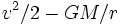
v^2/2 - G M / r \,

does not depend on the distance, r, from the center of the central body to the space vehicle in question. Therefore, the object can reach infinite r only if this quantity is nonnegative, which implies
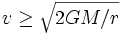
v\geq\sqrt{2 G M / r}

The escape velocity from the Earth's surface is about 11 km/s, but that is insufficient to send the body an infinite distance because of the gravitational pull of the Sun. To escape the solar system from the vicinity of the Earth requires around 42 km/s velocity, but there will be "part credit" for the Earth's orbital velocity for spacecraft launched from Earth, if their further acceleration (due to the propulsion system) carries them in the same direction as Earth travels in its orbit.

Formulae for free orbits


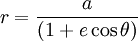
Orbits are conic sections, so, naturally, the formula for the distance of a body for a given angle corresponds to the formula for that curve in polar coordinates, which is:

r = {a \over (1 + e \cos \theta) }.

The parameters are given by the orbital elements.

Circular orbits


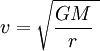
Although most orbits are elliptical in nature, a special case is the circular orbit, which is an ellipse of zero eccentricity. The formula for the velocity of a body in a circular orbit at distance r from the center of gravity of mass M is

\ v = \sqrt{\frac{GM} {r}\ }

where G is the gravitational constant, equal to

6.672 598 × 10−11 m3/(kg·s2)

To properly use this formula, the units must be consistent; for example, M must be in kilograms, and r must be in meters. The answer will be in meters per second.

The quantity GM is often termed the standard gravitational parameter, which has a different value for every planet or moon in the solar system.

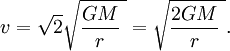
Once the circular orbital velocity is known, the escape velocity is easily found by multiplying by the square root of 2:

\ v = \sqrt 2\sqrt{\frac {GM} {r}\ } = \sqrt{\frac {2GM} {r}\ }.

MEMBERS LOGIN
  
EmailId:
Password:

  Forgot Password?
 New User? Register!
A D V E R T I S E M E N T
INTERVIEW EBOOK
Get 9,000+ Interview Questions & Answers in an eBook. Interview Question & Answer Guide
  • 9,000+ Interview Questions
  • All Questions Answered
  • 5 FREE Bonuses
  • Free Upgrades
START YOUR WEBSITE
India's Best Web Hosting Company
GATE RESOURCES
 
  • Gate Books
  • Training Institutes
  • Gate FAQs
  • GATE Exam, Gate 2009, Gate Papers, Gate Preparation & Related Pages


    GATE Overview | GATE Eligibility | Structure Of GATE | GATE Training Institutes | Colleges Providing M.Tech/M.E. | GATE Score | GATE Results | PG with Scholarships | Article On GATE | GATE Forum | GATE 2009 Exclusive | GATE 2009 Syllabus | GATE Organizing Institute | Important Dates for GATE Exam | How to Apply for GATE | Discipline / Branch Codes | GATE Syllabus for Aerospace Engineering | GATE Syllabus for Agricultural Engineering | GATE Syllabus for Architecture and Planning | GATE Syllabus for Chemical Engineering | GATE Syllabus for Chemistry | GATE Syllabus for Civil Engineering | GATE Syllabus for Computer Science / IT | GATE Syllabus for Electronics and Communication Engineering | GATE Syllabus for Engineering Sciences | GATE Syllabus for Geology and Geophysics | GATE Syllabus for Instrumentation Engineering | GATE Syllabus for Life Sciences | GATE Syllabus for Mathematics | GATE Syllabus for Mechanical Engineering | GATE Syllabus for Metallurgical Engineering | GATE Syllabus for Mining Engineering | GATE Syllabus for Physics | GATE Syllabus for Production and Industrial Engineering | GATE Syllabus for Pharmaceutical Sciences | GATE Syllabus for Textile Engineering and Fibre Science | GATE Preparation | GATE Pattern | GATE Tips & Tricks | GATE Compare Evaluation | GATE Sample Papers | GATE Downloads | Experts View on GATE | CEED 2009 | CEED 2009 Exam | Eligibility for CEED Exam | Application forms of CEED Exam | Important Dates of CEED Exam | Contact Address for CEED Exam | CEED Examination Centres | CEED Sample Papers | Discuss GATE | GATE Forum of OneStopGATE.com | GATE Exam Cities | Contact Details for GATE | Bank Details for GATE | GATE Miscellaneous Info | GATE FAQs | Advertisement on GATE | Contact Us on OneStopGATE |
    Copyright © 2009. One Stop Gate.com. All rights reserved Privacy Policies | About Us
    Our Portals : Academic Tutorials | Best eBooksworld | Beyond Stats | City Details | Interview Questions | Discussions World | Excellent Mobiles | Free Bangalore | Give Me The Code | Gog Logo | Indian Free Ads | Jobs Assist | New Interview Questions | One Stop FAQs | One Stop GATE | One Stop GRE | One Stop IAS | One Stop MBA | One Stop SAP | One Stop Testing | Quick2Host | Quick2Host Mirror | Quick Site Kit | Sirf Dosti | Source Codes World | Tasty Food | Tech Archive | Testing Interview Questions | Tests World | The Galz | Top Masala | Vyom | Vyom eBooks | Vyom International | Vyom Links | Vyoms | Vyom World
    C Interview Questions | C++ Interview Questions | Send Free SMS | Placement Papers | SMS Jokes