An Introduction to Digital Logic - Signals and Gates
Introduction - Why Do You
Want to Learn This Material?
In this lesson you're going to be
introduced to Digital Logic. There are lots of
reasons to learn digital logic. Here are some of those reasons.
Digital logic is the
foundation for digital computers. If you want to understand the innards of
computers you need to know digital logic.
Digital logic has relations
to other kinds of logic including:
Formal logic - as taught
by many philosophy departments
Fuzzy logic - a tool used
to design control systems and many other systems.
So, in learning digital
logic you learn something that helps you elsewhere.
For many students, learning
digital logic is fun.
What Are You Going to Learn?
There are at least two general areas you
need to become familiar with.
First, there's background you
need to know - the basics of digital logic - things like zeros and ones (0s
and 1s) and how you can represent signals as sequences of zeroes and ones.
Eventually you will want to know how large arrays of zeroes and ones can be
used in computer files to store information in pictures, documents, sounds
and even movies and you'll want to learn about how information can be
transmitted, between computers and digital signal sources.
You will also need to know
things about digital circuits - gates, flip-flops and memory elements and
others - so that you can eventually design circuits to manipulate digital
signals.
Here is a short list of the topics you will learn.
Learn what logic signals look
like
Model logic signals
Learn Boolean algebra for
logic analysis
Learn about gates that
process logic signals
Learn how to design some
smaller logic circuits
Learn about flip-flops and
memory elements that store logic signals
Objectives For This Lesson
Here's what we are after in this lesson - what
you should be able to do.
Given a system that uses logic signals
Be able to specify what the output will be when the input is zero (0)
and what the output will be when the input is one (1).
Given an AND, OR, NAND or NOT gate,
Be able to determine the output of the gate given the input logic
signals.
Given a system that requires gates,
Be able to wire a chip correctly, and to check that the chip is
functioning properly.
Logic Signals
There are a number of different systems
for representing binary information in physical systems. Here are a few.
A voltage signal with
zero (0)
corresponding to 0 volts
and one (1)
corresponding to five or three volts.
A sinusoidal signal with zero
corresponding to some frequency, and one corresponding to some other
frequency.
A current signal with
zero corresponding to 4 milliamps
and one corresponding to 20 milliamps.
And one last way is to
use switches, OPEN
for "0" and CLOSED
for "1".
(And there are more ways!)
Characteristics of Logic Signals
We should note that all of these signals
can and usually will change in time, so that we really are looking at dynamic
situations. However, we will start by looking at these signals as though they
were not changing in time.
We will pick a voltage
signal as a working example. It can take on two values corresponding to
0 and
1.
We can associate a
variable with that logic signal, and we can assign a symbol to represent
that variable - like the symbol A.
Think Binary!
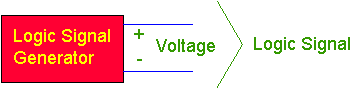
Let's examine a typical situation. You
have some sort of device that generates a logic signal.
It could be a telephone that
converts your voice signal into a sequence of zeros and ones.
It could be the thermostat on
the wall that generates a 1 when the temperature is too low, and a 0 when
the temperature is above the set point temperature.
The logic signal, A,
takes on values of 0 (FALSE, OFF) or
1 (TRUE, ON). That signal might really be a
voltage, a switch closure, etc. However, we want to think in terms of zeros and
ones, not in terms of the values of the voltage.
Operations on Logic Signals
Once we have the concept of a logic signal
we can talk about operations that can be performed on logic signals. Begin by
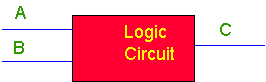
assuming we have two logic signals, A and
B. Then assume that those two signals form an
input set to some circuit that takes two logic signals as inputs, and has an
output that is also a logic signal. That situation is represented below.
The output, C, depends upon the inputs, A and
B. There are many different ways that C could depend upon A and B. The output,
C, is a function, - a logic function - of the inputs, A and B. IWe will examine
a few basic logic functions - AND,
OR and NOT functions
and start learning the circuitry that you use to implement those functions.
Logic Gates
If we think of two signals, A and B, as
representing a truth value of two different
propositions, then A could be either TRUE (a logical 1)
or FALSE (a logical 0). B can take on the same
values. Now consider a situation in which the output, C, is TRUE only when both
A is TRUE and B is TRUE. We can construct a truth table
for this situation. In that truth table, we insert all of the possible
combinations of inputs, A and B, and for every combination of A and B we list
the output, C.
A
B
C
False
False
False
False
True
False
True
False
False
True
True
True
An AND Example
Let's imagine a physician prescribing two
drugs. For some conditions drug A is prescribed,
and for other conditions drug B is prescribed.
Taken separately each drug is safe. When used together dangerous side effects
are produced.
Let
A = Truth of the
statement "Drug 'A' is prescribed.".
B = Truth of the
statement "Drug 'B' is prescribed.".
C = Truth of the
statement "The patient is in danger.".
Then, the truth table
below shows when the patient is in danger.
A
B
C
False
False
False
False
True
False
True
False
False
True
True
True
Notice that C is TRUE when both A AND B are true
and only then!
AND GATES
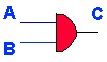
An AND function can be implemented
electrically using a device known as an AND gate. You might imagine a system in
which zero (0) is represented by zero (0) volts, and one (1) is represented by
three (3) volts, for example. If we are going to use electrical devices we need
some sort of symbolic representation. There is a standard symbol for an AND
gate shown below.
Often in lab work it's helpful to use an
LED to show when a signal is 0 or
1. Usually a 1 is
indicated with an LED that is ON (i.e. glowing). You can use the buttons below
to check out this AND gate (Note what an AND gate symbol looks like!) with a
simulated LED. Note the following in the simulation (and you can use this in
your lab experiments).
To get a logical
zero, connect the input
of the gate to ground to have zero (0) volts
input.
To get a logical
one, connect the input of
the gate to a five (5) volts source to have
five volts at the input.
Each button controls one
switch (two buttons - two switches) so that you can control the individual
inputs to the gate.
Each time you click a
button, you toggle
the switch to the opposite position.
Question
Q1.
You have an AND gate. Both inputs are zero. What is the
output?
We now have two
ways of representing an AND gate, the truth table and the circuit diagram.
However, there is a third way of representing this information - a symbolic
way - that will take us toward Boolean algebra.
Let us consider our variables, A, B and C
to be algebraic variables, but algebraic variables that can only take on two
values, 0 and 1. Then we represent the AND function symbolically in either of
two ways.
C = A�B or
C = AB
Some will prefer always to insert the dot
between the variables so that the AND operation is clearly indicated. Many
times, the context will allow you just to use AB, without a dot between A and
B, but if there is a variable named AB, then
confusion can arise.
Problems
Assume you have an AND
gate with two inputs, A and B. Determine the output,
C, for the following cases.
P1.
A = 1, B = 0
P2.
A = 0, B = 1
P3.
If either input is zero, what is the output?
P4.
A = 1, B = 1
Once we introduce Boolean variables, we can
rethink the concept of a truth table. In the truth table below, if A, B and C
are truth tables and we have an AND gate with A and B as inputs and C as the
output, the truth table would look like this.
A
B
C
0
0
0
0
1
0
1
0
0
1
1
1
OR Gates
Consider a case where a pressure can be
high and a temperature can be high Let's assume we have two sensors that measure
temperature and pressure.. The first sensor has an output, T, that is
1 when a temperature in a boiler is too high, and
0 otherwise. The second sensor produces an output,
P, that is 1 when the pressure is too high, and
0 otherwise. Now, for the boiler, we have a
dangerous situation when either the temperature or the pressure is too high. It
only takes one. Let's construct a truth table for this situation. The output,
D, is 1 when danger exists.
T
P
D
False
False
False
False
True
True
True
False
True
True
True
True
What we have done is defined an
ORgate. An OR gate is a gate for which the output
is 1 whenever one or more of the inputs is 1. The
output of an OR gate is 0 only when all inputs are
0. Shown below is a schematic symbol for an OR gate, together with the
simulated LEDs and input buttons so that you can explore OR gate behavior.
In terms of Boolean variables, the truth table for
an OR gate looks like this.
A
B
C
0
0
0
0
1
1
1
0
1
1
1
1
Problems
Assume you have an OR gate
with two inputs, A and B. Determine the output, C, for the following cases.
P5.
A = 1, B = 0
P6.
A = 0, B = 1
P7.
If either input is one, what is the output?
NOT Gates
(Inverters)
A third important logical element is the
inverter. An inverter does pretty much what it says. If the input is
0, the output is 1.
Conversely, if the input is 1, the output is
0. The symbol for an inverter is shown below.
Again, you can putter with this inverter with the simulated LEDs.
X is the input to the inverter. The output is
NOT-X represented as ~1 or:
The truth table for an inverter is
pretty simple since there is only one input. Call the input A, and the output
C, and the truth table is:
A
C
0
1
1
0
Example Problem
You need to control two
pumps that supply two different concentrations of reactant to a chemical
process. The strong reactant is used when pH is very far from the desired
value, and the weak reactant when pH is close to desired.
You need to ensure that
only one of the two pumps runs at any time. Each pump controller responds to
standard logic signals, that is when the input to the pump controller is 1, the
pump operates, and when that input is 0, the pump does not operate.
You have a bunch of
two-input AND gates (IC chips), OR gates and Inverters, and you need to design a
logic circuit to control the pumps. You can generate a signal that is 1 when
Pump S is ON, and 0 when Pump W is ON. Can you design the circuit?
In order to solve the
problem, consider that the pump controls should receive logical inverse
signals. When one pump signal is one, the other is zero. Given that
recognition this circuit should work. Here, if X is 1, Pump S pumps.
Notice the simple way we can
use a switch and a five volt supply to produce a single logic signal that is
""0"" (ground) or 1 (5
volts).






 Given a system that uses logic signals
 Be able to specify what the output will be when the input is zero (0)
and what the output will be when the input is one (1).
Be able to specify what the output will be when the input is zero (0)
and what the output will be when the input is one (1).