OneStopGate.Com
OnestopGate   OnestopGate

  JOIN GATE GROUP, Looking for GATE Preparation Materials? Join & Get GATE Preparation Materials now!, JOIN GATE GROUP
OnestopGate
Home | Overview | Syllabus | Tutorials | FAQs | Downloads | Advertise | Contact Us | Forum
OneStopGate

GATE Overview
  arrow to indicate  Overview
  arrow to indicate  GATE Eligibility
  arrow to indicate  Structure Of GATE
  arrow to indicate  GATE Coaching       Centers
  arrow to indicate  Colleges Providing M.Tech/M.E.
  arrow to indicate  GATE Score
  arrow to indicate  GATE Results
  arrow to indicate  PG with Scholarships
  arrow to indicate  Article On GATE
  arrow to indicate  GATE Forum

GATE 2009 Exclusive
  arrow to indicate  GATE 2009 Syllabus
  arrow to indicate  GATE Organizing Institute
  arrow to indicate  Important Dates
  arrow to indicate  How to Apply
  arrow to indicate  Discipline Codes

GATE Syllabus
  arrow to indicate  Aerospace Engg..
  arrow to indicate  Agricultural Engg..
  arrow to indicate  Architecture and Planning
  arrow to indicate  Chemical Engg..
  arrow to indicate  Chemistry
  arrow to indicate  Civil Engg..
  arrow to indicate  Computer Science / IT
  arrow to indicate  Electronics & Communication Engg..
  arrow to indicate  Electrical Engg..
  arrow to indicate  Engineering Sciences
  arrow to indicate  Geology and Geophysics
  arrow to indicate  Instrumentation Engineering
  arrow to indicate  Life Sciences
  arrow to indicate  Mathematics
  arrow to indicate  Mechanical Engg..
  arrow to indicate  Metallurgical Engg..
  arrow to indicate  Mining Engg..
  arrow to indicate  Physics
  arrow to indicate  Production & Industrial Engg..
  arrow to indicate  Pharmaceutical Sciences
  arrow to indicate  Textile Engineering and Fibre Science

GATE Study Material
  arrow to indicate  Aerospace Engg..
  arrow to indicate  Agricultural Engg..
  arrow to indicate  Chemical Engg..
  arrow to indicate  Chemistry
  arrow to indicate  Civil Engg..
  arrow to indicate  Computer Science /       IT
  arrow to indicate  Electronics &       Communication Engg..
  arrow to indicate  Electrical Engg..
  arrow to indicate  Engineering Sciences
  arrow to indicate  Instrumentation       Engg..
  arrow to indicate  Life Sciences
  arrow to indicate  Mathematics
  arrow to indicate  Mechanical Engg..
  arrow to indicate  Physics
  arrow to indicate  Pharmaceutical       Sciences
  arrow to indicate  Textile Engineering        and Fibre Science

GATE Preparation
  arrow to indicate  GATE Pattern
  arrow to indicate  GATE Tips N Tricks
  arrow to indicate  Compare Evaluation
  arrow to indicate  Sample Papers
  arrow to indicate  GATE Downloads
  arrow to indicate  Experts View

CEED 2009
  arrow to indicate  CEED Exams
  arrow to indicate  Eligibility
  arrow to indicate  Application Forms
  arrow to indicate  Important Dates
  arrow to indicate  Contact Address
  arrow to indicate  Examination Centres
  arrow to indicate  CEED Sample Papers

Discuss GATE
  arrow to indicate  GATE Forum
  arrow to indicate  Exam Cities
  arrow to indicate  Contact Details
  arrow to indicate  Bank Details

Miscellaneous
  arrow to indicate  GATE FAQs
  arrow to indicate  Advertisment
  arrow to indicate  Contact Us

Home » Gate Study Material » Electrical Engineering » Electrical Elements » Resistor

Resistor

Looking for GATE Preparation Material? Join & Get here now!
Discussion Center

Discuss/
Query

Papers/ Syllabus

Feedback/
Suggestion

Yahoo
Groups

Sirfdosti
Groups

Contact
Us
  Print
Next>>
Resistor

Resistors

        There are many different types of electrical components.  Shown below is a photograph of part of a circuit board.  On this circuit board are many electrical components including some resistors.
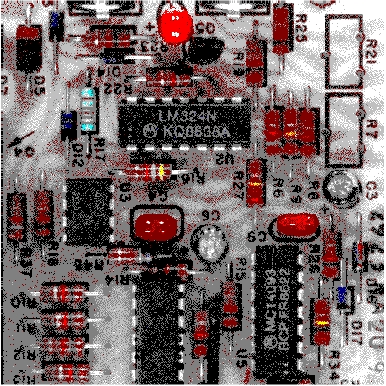
        There are resistors, capacitors, diodes and integrated circuits.  Using plated copper and solder on the reverse side of the board, these components are interconnected and when a supply voltage is provided, these components can interact.  Electrical engineers need to know how to design larger circuits like this and to control those interactions to achieve some purpose.

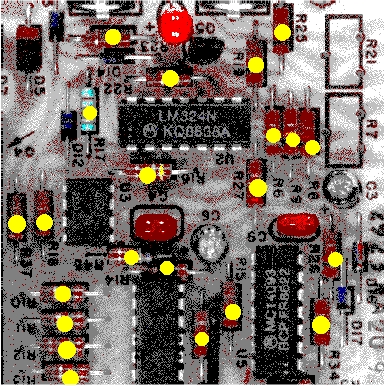
        In this lesson you are going to learn about the simplest sort of electrical component, the resistor.  What you learn about resistors is a starting point.  That knowledge helps you as you begin to learn about all of the other kinds of electrical/electronic components.  Still, although resistors are basic elements, they occur everywhere.  On the board below, all of the resistors are marked with a yellow dot.


Goals

        This lesson introduces you to some simple concepts about resistors and resistance.  At the end of the lesson, you want to be able to do the following.

   Given a common electrical device,
   Know when the device is a resistor
   Given a resistor
   Be able to use Ohm's Law to compute resistance when voltage and current are given,
   Be able to use Ohm's Law to compute voltage when resistance and current are given,
   Be able to use Ohm's Law to compute current when voltage and resistance are given.

        Almost every electrical product is constructed from a collection of fundamental electrical components.  For example,
  • a radio,
  • a portable tape player,
  • a television,
  • a telephone,
  • a cellular phone,
  • the electronic ignition in a car,
  • a computer circuit board
are all built from smaller electrical components.  There are many different kinds of components, including
  • resistors,
  • capacitors,
  • inductors,
  • transistors,
  • microwave generating tubes,
  • and many more.
        These devices can be combined to form many different kinds of circuits and devices including all of the appliances listed earlier as well as all the various forms of computers we use daily.  If you want to be able to design electrical and electronic circuits to perform a useful function you need to start by learning about components, and we will start with resistors.

        The array of electrical components now available includes a vast and diverse number of components with varying shapes and numbers of leads.  Here are  some more electrical components you may be familiar with:

  • light bulbs,
  • computer chips,
  • solar cells,
  • inductors,
  • heating elements on stoves,
  • Light Emitting Diode (LED) displays on calculators,
  • operational amplifiers,
  • thermistors,
  • and many others.
        Some of the electrical devices on our list have something in common.  There are many ways of categorizing them.  For example, you might look for elements with two leads or those with three leads.  You might also look for those elements which interact with other physical variables (for example, speakers which produce sound in a stereo, or a light bulb which generates light).

        One way of categorizing the items on the previous page is that all of the items above produce heat as a by-product of their operation.  Here are some more devices that produce heat when a voltage is applied - a stove heating element, a toaster and two light bulbs.

In fact, all of the items on the pictures above are resistors.


Q1-10   Here's a little quiz for you.  Click on the check boxes below for the elements that are resistors.


        There are numerous places where resistors are used.  Here are some places where resistors are used.
 
  • Heating Applications:
    • Home baseboard heaters
    • Toasters
    • Clothes Dryers
  • Measurement Applications:
    • Photoresistors to measure light intensity (Photgraphic light meters in a camera)
    • Thermistors to measure temperature
    • Strain gages to measure strain (Used in bathroom scales, measurements on bridges)
        Resistors are ubiquitous today.  They are literally everywhere, not only in electronic equipment but are they are in many of the ordinary devices we rely on like toasters, irons, stoves and light bulbs.

        To really understand resistors you need to understand the law they obey - Ohm's Law - which gives a relationship between the current through a resistor and the voltage across the resistor.  That's something you may not have considered yet.  A resistor is a device that establishes a unique relationship between a current and a voltage.


Ohm's Law - What You Need To Know About Resistors.
 
The Genesis of Electrical Devices and Theories

        Work on electrical devices all started with resistors and resistance. The concept of resistance was first enunciated by Georg Simon Ohm who was the first to point out that voltage and current in a wire were related mathematically.   That's an important idea.  Since Ohm's time many different devices have been discovered and generalizations of Ohms' Law are used to describe those devices.

        Ohm found that mathematics could be applied to what was going on in resistors, and the mathematical relation he found was just the start of the application of mathematics to electrical phenomena.

The Application of Mathematics to Electrical Science

        You are probably accustomed to the idea that physical phenomena can be described using the language of mathematics.  That's an idea that wasn't always accepted, and when Ohm first proposed to describe electrical phenomena using mathematics he was taken to task vehemently.  (That happened even though Newton had described mechanical phenomena mathematically two hundred years earlier, and had, in fact, invented calculus in order to do that!)

        Ohm didn't even have the concepts of current and voltage to work with.  He had to invent the concepts and then show that there was an experimental relationship between voltage and current, and that that relationship could be described mathematically.

        It all sounds simple today, especially since we have nice clean concepts of voltage and current as we discussed in the first chapter.  In Ohm's time, things were not so clear, and his discoveries really include clarification of the concepts of voltage and current as well as resistance.

        Working with very primitive instruments that he designed and constructed himself, Ohm discovered that voltage and current were linearly related in wires.  That means that if you measure voltage across a wire and plot that against the current through the wire you get a straight line in the plot.

        Working with very imprecise measurements, Ohm was able to determine that voltage and current for any fixed geometrical structure built from conducting material satisfied a relationship:

V = I R

where

  • V is the voltage across the device,
  • I is the current flowing through the device,
  • R is a constant.
  • R depends upon the material from which the device is constructed and the geometry of the material.
        There are several different ways that Ohm's Law can be represented.
  • Graphically:
    • We can draw/sketch/diagram/plot the relationship.
  • Mathematically:
    • We can represent the relationship mathematically with anequation:
      • Vr = Ir R
  • Symbolically:
    • We can devise a symbol for the resistor and use it in circuit diagrams to stand for any element that satisfies Ohm'sLaw.  The standard symbol is shown below along with polarity definitions for the voltage and current.
        We will use the symbol R for any resistor, although there will occasionaly be devices (like light bulbs) that are really resistors but which have a special symbol that can be used for them.  Still, you can use this symbol for an resistive device.
Next>>

MEMBERS LOGIN
  
EmailId:
Password:

  Forgot Password?
 New User? Register!
A D V E R T I S E M E N T
INTERVIEW EBOOK
Get 9,000+ Interview Questions & Answers in an eBook. Interview Question & Answer Guide
  • 9,000+ Interview Questions
  • All Questions Answered
  • 5 FREE Bonuses
  • Free Upgrades
START YOUR WEBSITE
India's Best Web Hosting Company
GATE RESOURCES
 
  • Gate Books
  • Training Institutes
  • Gate FAQs
  • GATE Exam, Gate 2009, Gate Papers, Gate Preparation & Related Pages


    GATE Overview | GATE Eligibility | Structure Of GATE | GATE Training Institutes | Colleges Providing M.Tech/M.E. | GATE Score | GATE Results | PG with Scholarships | Article On GATE | GATE Forum | GATE 2009 Exclusive | GATE 2009 Syllabus | GATE Organizing Institute | Important Dates for GATE Exam | How to Apply for GATE | Discipline / Branch Codes | GATE Syllabus for Aerospace Engineering | GATE Syllabus for Agricultural Engineering | GATE Syllabus for Architecture and Planning | GATE Syllabus for Chemical Engineering | GATE Syllabus for Chemistry | GATE Syllabus for Civil Engineering | GATE Syllabus for Computer Science / IT | GATE Syllabus for Electronics and Communication Engineering | GATE Syllabus for Engineering Sciences | GATE Syllabus for Geology and Geophysics | GATE Syllabus for Instrumentation Engineering | GATE Syllabus for Life Sciences | GATE Syllabus for Mathematics | GATE Syllabus for Mechanical Engineering | GATE Syllabus for Metallurgical Engineering | GATE Syllabus for Mining Engineering | GATE Syllabus for Physics | GATE Syllabus for Production and Industrial Engineering | GATE Syllabus for Pharmaceutical Sciences | GATE Syllabus for Textile Engineering and Fibre Science | GATE Preparation | GATE Pattern | GATE Tips & Tricks | GATE Compare Evaluation | GATE Sample Papers | GATE Downloads | Experts View on GATE | CEED 2009 | CEED 2009 Exam | Eligibility for CEED Exam | Application forms of CEED Exam | Important Dates of CEED Exam | Contact Address for CEED Exam | CEED Examination Centres | CEED Sample Papers | Discuss GATE | GATE Forum of OneStopGATE.com | GATE Exam Cities | Contact Details for GATE | Bank Details for GATE | GATE Miscellaneous Info | GATE FAQs | Advertisement on GATE | Contact Us on OneStopGATE |
    Copyright © 2009. One Stop Gate.com. All rights reserved Privacy Policies | About Us
    Our Portals : Academic Tutorials | Best eBooksworld | Beyond Stats | City Details | Interview Questions | Discussions World | Excellent Mobiles | Free Bangalore | Give Me The Code | Gog Logo | Indian Free Ads | Jobs Assist | New Interview Questions | One Stop FAQs | One Stop GATE | One Stop GRE | One Stop IAS | One Stop MBA | One Stop SAP | One Stop Testing | Quick2Host | Quick2Host Mirror | Quick Site Kit | Sirf Dosti | Source Codes World | Tasty Food | Tech Archive | Testing Interview Questions | Tests World | The Galz | Top Masala | Vyom | Vyom eBooks | Vyom International | Vyom Links | Vyoms | Vyom World
    C Interview Questions | C++ Interview Questions | Send Free SMS | Placement Papers | SMS Jokes