OneStopGate.Com
OnestopGate   OnestopGate

  JOIN GATE GROUP, Looking for GATE Preparation Materials? Join & Get GATE Preparation Materials now!, JOIN GATE GROUP
OnestopGate
Home | Overview | Syllabus | Tutorials | FAQs | Downloads | Advertise | Contact Us | Forum
OneStopGate

GATE Overview
  arrow to indicate  Overview
  arrow to indicate  GATE Eligibility
  arrow to indicate  Structure Of GATE
  arrow to indicate  GATE Coaching       Centers
  arrow to indicate  Colleges Providing M.Tech/M.E.
  arrow to indicate  GATE Score
  arrow to indicate  GATE Results
  arrow to indicate  PG with Scholarships
  arrow to indicate  Article On GATE
  arrow to indicate  GATE Forum

GATE 2009 Exclusive
  arrow to indicate  GATE 2009 Syllabus
  arrow to indicate  GATE Organizing Institute
  arrow to indicate  Important Dates
  arrow to indicate  How to Apply
  arrow to indicate  Discipline Codes

GATE Syllabus
  arrow to indicate  Aerospace Engg..
  arrow to indicate  Agricultural Engg..
  arrow to indicate  Architecture and Planning
  arrow to indicate  Chemical Engg..
  arrow to indicate  Chemistry
  arrow to indicate  Civil Engg..
  arrow to indicate  Computer Science / IT
  arrow to indicate  Electronics & Communication Engg..
  arrow to indicate  Electrical Engg..
  arrow to indicate  Engineering Sciences
  arrow to indicate  Geology and Geophysics
  arrow to indicate  Instrumentation Engineering
  arrow to indicate  Life Sciences
  arrow to indicate  Mathematics
  arrow to indicate  Mechanical Engg..
  arrow to indicate  Metallurgical Engg..
  arrow to indicate  Mining Engg..
  arrow to indicate  Physics
  arrow to indicate  Production & Industrial Engg..
  arrow to indicate  Pharmaceutical Sciences
  arrow to indicate  Textile Engineering and Fibre Science

GATE Study Material
  arrow to indicate  Aerospace Engg..
  arrow to indicate  Agricultural Engg..
  arrow to indicate  Chemical Engg..
  arrow to indicate  Chemistry
  arrow to indicate  Civil Engg..
  arrow to indicate  Computer Science /       IT
  arrow to indicate  Electronics &       Communication Engg..
  arrow to indicate  Electrical Engg..
  arrow to indicate  Engineering Sciences
  arrow to indicate  Instrumentation       Engg..
  arrow to indicate  Life Sciences
  arrow to indicate  Mathematics
  arrow to indicate  Mechanical Engg..
  arrow to indicate  Physics
  arrow to indicate  Pharmaceutical       Sciences
  arrow to indicate  Textile Engineering        and Fibre Science

GATE Preparation
  arrow to indicate  GATE Pattern
  arrow to indicate  GATE Tips N Tricks
  arrow to indicate  Compare Evaluation
  arrow to indicate  Sample Papers
  arrow to indicate  GATE Downloads
  arrow to indicate  Experts View

CEED 2009
  arrow to indicate  CEED Exams
  arrow to indicate  Eligibility
  arrow to indicate  Application Forms
  arrow to indicate  Important Dates
  arrow to indicate  Contact Address
  arrow to indicate  Examination Centres
  arrow to indicate  CEED Sample Papers

Discuss GATE
  arrow to indicate  GATE Forum
  arrow to indicate  Exam Cities
  arrow to indicate  Contact Details
  arrow to indicate  Bank Details

Miscellaneous
  arrow to indicate  GATE FAQs
  arrow to indicate  Advertisment
  arrow to indicate  Contact Us

Home » Gate Study Material » Electrical Engineering » Time and Frequency » System Dynamics - Time Constants

System Dynamics - Time Constants

Looking for GATE Preparation Material? Join & Get here now!
Discussion Center

Discuss/
Query

Papers/ Syllabus

Feedback/
Suggestion

Yahoo
Groups

Sirfdosti
Groups

Contact
Us
  Print
Next>>
System Dynamics - Time Constants

Time Constants - Where are they found?

        Time Constants are ubiquitous.  They are found in many different kinds of systems, including the following.

  • Electrical Systems.

    • Resistor-Capacitor circuits have time constants.

    • Resistor-Inductor circuits have time constants.

  • Mechanical Systems

    • Many motions exhibit time-constant behavior.  For example when a motor speeds up, the measurements of speed would reveal time-constant behavior.

  • Thermal Systems

    • Heating up and cooling down in simple thermal systems shows time-constant behavior.  Lakes cooling off after the summer slow down the approach of winter near the lake, and later lakes slowly heating up in the spring retard the approach of summer.  That behavior can be explained using time constants.

  • Physiological Systems

    • The inner ear has dynamics that can be explained using two time constants

  • Psychological Systems

    • Psychologists have measured the time constant that determines how much learned material you retain as a function of time after learning.


How Do Time Constants Come About?

        Time constants are parameters of systems that obey first order, linear differential equations.  That would be a differential equation like this one.

t(dx(t)/dt) + x(t) = Gu(t)

        In this situation, the variables are:

  • x(t) = response

  • u(t) = input or driving function

  • Examples:

    • u(t) = heat in, x(t) = temperature

    • u(t) = voltage into a circuit, x(t) = output voltage

    • u(t) = voltage driving a motor, x(t) = motor speed.

        The constants in the differential equation are:

  • t = the Time Constant
    • The time constant is a measure of how quickly the system responds.

  • G = the System Gain

    • At steady state, the response, x(t), can be calculated by multiplying the input by the gain, G.

             The responses you need to know about for this sytem include:
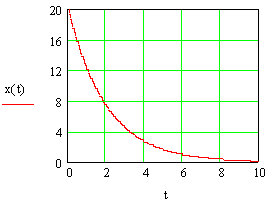
  • Response when the input is zero (There is no input), but the output has some initial value.

    • x(t) = x(0)e-t/t, which looks like:

    • Examples:

      • Motor slowing down when the power is turned off.

      • Temperature rise above ambient decaying to zero when the heat source is turned off.

  • Response when the input is a constant (Commonly called the Step Response), which looks like:

    • x(t) = G*u*(1 - e-t/t)

    • Examples:

      • Motor speeding up when the power is turned on.

      • Temperature rising when the heat is turned on.


Measuring Time Constants

        In many experimental situations you need to measure the time constant of a system.  In this section we will examine properties of time constant response that permit you to get a measurement of a time constant.

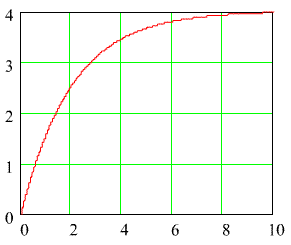
        We start by examining some typical time-constant behavior.  Here is a response of a first order system that exhibits time response behavior.

We need to think about the features of this response that will permit us to get measurements that look like this and determine the time constant of the system from these kinds of measurements.

        If this is the impulse response of a system, it would have this for.

x(t) = (Gdc/t)e-t/t

The general form is given by:

x(t) = x(0)e-t/t

We can look for important points in this response.  The most obvious is when t = t.  That's when the elapsed time is one time constant.  When one time constant has elapsed the response is:

x(t) = x(0)e-1 = x(0)(0.36788)

Next>>

MEMBERS LOGIN
  
EmailId:
Password:

  Forgot Password?
 New User? Register!
A D V E R T I S E M E N T
INTERVIEW EBOOK
Get 9,000+ Interview Questions & Answers in an eBook. Interview Question & Answer Guide
  • 9,000+ Interview Questions
  • All Questions Answered
  • 5 FREE Bonuses
  • Free Upgrades
START YOUR WEBSITE
India's Best Web Hosting Company
GATE RESOURCES
 
  • Gate Books
  • Training Institutes
  • Gate FAQs
  • GATE Exam, Gate 2009, Gate Papers, Gate Preparation & Related Pages


    GATE Overview | GATE Eligibility | Structure Of GATE | GATE Training Institutes | Colleges Providing M.Tech/M.E. | GATE Score | GATE Results | PG with Scholarships | Article On GATE | GATE Forum | GATE 2009 Exclusive | GATE 2009 Syllabus | GATE Organizing Institute | Important Dates for GATE Exam | How to Apply for GATE | Discipline / Branch Codes | GATE Syllabus for Aerospace Engineering | GATE Syllabus for Agricultural Engineering | GATE Syllabus for Architecture and Planning | GATE Syllabus for Chemical Engineering | GATE Syllabus for Chemistry | GATE Syllabus for Civil Engineering | GATE Syllabus for Computer Science / IT | GATE Syllabus for Electronics and Communication Engineering | GATE Syllabus for Engineering Sciences | GATE Syllabus for Geology and Geophysics | GATE Syllabus for Instrumentation Engineering | GATE Syllabus for Life Sciences | GATE Syllabus for Mathematics | GATE Syllabus for Mechanical Engineering | GATE Syllabus for Metallurgical Engineering | GATE Syllabus for Mining Engineering | GATE Syllabus for Physics | GATE Syllabus for Production and Industrial Engineering | GATE Syllabus for Pharmaceutical Sciences | GATE Syllabus for Textile Engineering and Fibre Science | GATE Preparation | GATE Pattern | GATE Tips & Tricks | GATE Compare Evaluation | GATE Sample Papers | GATE Downloads | Experts View on GATE | CEED 2009 | CEED 2009 Exam | Eligibility for CEED Exam | Application forms of CEED Exam | Important Dates of CEED Exam | Contact Address for CEED Exam | CEED Examination Centres | CEED Sample Papers | Discuss GATE | GATE Forum of OneStopGATE.com | GATE Exam Cities | Contact Details for GATE | Bank Details for GATE | GATE Miscellaneous Info | GATE FAQs | Advertisement on GATE | Contact Us on OneStopGATE |
    Copyright © 2009. One Stop Gate.com. All rights reserved Privacy Policies | About Us
    Our Portals : Academic Tutorials | Best eBooksworld | Beyond Stats | City Details | Interview Questions | Discussions World | Excellent Mobiles | Free Bangalore | Give Me The Code | Gog Logo | Indian Free Ads | Jobs Assist | New Interview Questions | One Stop FAQs | One Stop GATE | One Stop GRE | One Stop IAS | One Stop MBA | One Stop SAP | One Stop Testing | Quick2Host | Quick2Host Mirror | Quick Site Kit | Sirf Dosti | Source Codes World | Tasty Food | Tech Archive | Testing Interview Questions | Tests World | The Galz | Top Masala | Vyom | Vyom eBooks | Vyom International | Vyom Links | Vyoms | Vyom World
    C Interview Questions | C++ Interview Questions | Send Free SMS | Placement Papers | SMS Jokes