OneStopGate.Com
OnestopGate   OnestopGate

  JOIN GATE GROUP, Looking for GATE Preparation Materials? Join & Get GATE Preparation Materials now!, JOIN GATE GROUP
OnestopGate
Home | Overview | Syllabus | Tutorials | FAQs | Downloads | Advertise | Contact Us | Forum
OneStopGate

GATE Overview
  arrow to indicate  Overview
  arrow to indicate  GATE Eligibility
  arrow to indicate  Structure Of GATE
  arrow to indicate  GATE Coaching       Centers
  arrow to indicate  Colleges Providing M.Tech/M.E.
  arrow to indicate  GATE Score
  arrow to indicate  GATE Results
  arrow to indicate  PG with Scholarships
  arrow to indicate  Article On GATE
  arrow to indicate  GATE Forum

GATE 2009 Exclusive
  arrow to indicate  GATE 2009 Syllabus
  arrow to indicate  GATE Organizing Institute
  arrow to indicate  Important Dates
  arrow to indicate  How to Apply
  arrow to indicate  Discipline Codes

GATE Syllabus
  arrow to indicate  Aerospace Engg..
  arrow to indicate  Agricultural Engg..
  arrow to indicate  Architecture and Planning
  arrow to indicate  Chemical Engg..
  arrow to indicate  Chemistry
  arrow to indicate  Civil Engg..
  arrow to indicate  Computer Science / IT
  arrow to indicate  Electronics & Communication Engg..
  arrow to indicate  Electrical Engg..
  arrow to indicate  Engineering Sciences
  arrow to indicate  Geology and Geophysics
  arrow to indicate  Instrumentation Engineering
  arrow to indicate  Life Sciences
  arrow to indicate  Mathematics
  arrow to indicate  Mechanical Engg..
  arrow to indicate  Metallurgical Engg..
  arrow to indicate  Mining Engg..
  arrow to indicate  Physics
  arrow to indicate  Production & Industrial Engg..
  arrow to indicate  Pharmaceutical Sciences
  arrow to indicate  Textile Engineering and Fibre Science

GATE Study Material
  arrow to indicate  Aerospace Engg..
  arrow to indicate  Agricultural Engg..
  arrow to indicate  Chemical Engg..
  arrow to indicate  Chemistry
  arrow to indicate  Civil Engg..
  arrow to indicate  Computer Science /       IT
  arrow to indicate  Electronics &       Communication Engg..
  arrow to indicate  Electrical Engg..
  arrow to indicate  Engineering Sciences
  arrow to indicate  Instrumentation       Engg..
  arrow to indicate  Life Sciences
  arrow to indicate  Mathematics
  arrow to indicate  Mechanical Engg..
  arrow to indicate  Physics
  arrow to indicate  Pharmaceutical       Sciences
  arrow to indicate  Textile Engineering        and Fibre Science

GATE Preparation
  arrow to indicate  GATE Pattern
  arrow to indicate  GATE Tips N Tricks
  arrow to indicate  Compare Evaluation
  arrow to indicate  Sample Papers
  arrow to indicate  GATE Downloads
  arrow to indicate  Experts View

CEED 2009
  arrow to indicate  CEED Exams
  arrow to indicate  Eligibility
  arrow to indicate  Application Forms
  arrow to indicate  Important Dates
  arrow to indicate  Contact Address
  arrow to indicate  Examination Centres
  arrow to indicate  CEED Sample Papers

Discuss GATE
  arrow to indicate  GATE Forum
  arrow to indicate  Exam Cities
  arrow to indicate  Contact Details
  arrow to indicate  Bank Details

Miscellaneous
  arrow to indicate  GATE FAQs
  arrow to indicate  Advertisment
  arrow to indicate  Contact Us

Home » Gate Study Material » Electronics and Telecommunication » Antennas » Antenna polarisation or polarization

Antenna polarisation or polarization

Looking for GATE Preparation Material? Join & Get here now!
Discussion Center

Discuss/
Query

Papers/
Syllabus

Feedback/
Suggestion

Yahoo
Groups

Sirfdosti
Groups

Contact
Us
  Print
Antenna polarisation or polarization

Antenna polarisation or polarization


- overview, summary, tutorial about RF antenna or aerial polarisation and the effect polarization has on RF antennas and radio communications.


Polarisation is an important factor for RF antennas and radio communications in general. Both RF antennas and electromagnetic waves are said to have a polarization. For the electromagnetic wave the polarization is effectively the plane in which the electric wave vibrates. This is important when looking at antennas because they are sensitive to polarisation, and generally only receive or transmit a signal with a particular polarization. For most antennas it is very easy to determine the polarization. It is simply in the same plane as the elements of the antenna. So a vertical antenna (i.e. one with vertical elements) will receive vertically polarised signals best and similarly a horizontal antenna will receive horizontally polarised signals.
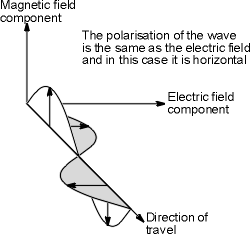
Polarisation of an electromagnetic wave

An electromagnetic wave


It is important to match the polarization of the RF antenna to that of the incoming signal. In this way the maximum signal is obtained. If the RF antenna polarization does not match that of the signal there is a corresponding decrease in the level of the signal. It is reduced by a factor of cosine of the angle between the polarisation of the RF antenna and the signal.

Accordingly the polarisation of the antennas located in free space is very important, and obviously they should be in exactly the same plane to provide the optimum signal. If they were at right angles to one another (i.e. cross-polarised) then in theory no signal would be received.

For terrestrial radio communications applications it is found that once a signal has been transmitted then its polarisation will remain broadly the same. However reflections from objects in the path can change the polarisation. As the received signal is the sum of the direct signal plus a number of reflected signals the overall polarisation of the signal can change slightly although it remains broadly the same.


Polarisation catagories


Vertical and horizontal are the simplest forms of antenna polarization and they both fall into a category known as linear polarisation. However it is also possible to use circular polarisation. This has a number of benefits for areas such as satellite applications where it helps overcome the effects of propagation anomalies, ground reflections and the effects of the spin that occur on many satellites. Circular polarisation is a little more difficult to visualise than linear polarisation. However it can be imagined by visualising a signal propagating from an RF antenna that is rotating. The tip of the electric field vector will then be seen to trace out a helix or corkscrew as it travels away from the antenna. Circular polarisation can be seen to be either right or left handed dependent upon the direction of rotation as seen from the transmitter.

Another form of polarisation is known as elliptical polarisation. It occurs when there is a mix of linear and circular polarisation. This can be visualised as before by the tip of the electric field vector tracing out an elliptically shaped corkscrew.

However it is possible for linearly polarised antennas to receive circularly polarised signals and vice versa. The strength will be equal whether the linearly polarised antenna is mounted vertically, horizontally or in any other plane but directed towards the arriving signal. There will be some degradation because the signal level will be 3 dB less than if a circularly polarised antenna of the same sense was used. The same situation exists when a circularly polarised antenna receives a linearly polarised signal.


Applications of antenna polarization


Different types of polarisation are used in different applications to enable their advantages to be used. Linear polarization is by far the most widely used for most radio communications applications. Vertical polarisation is often used for mobile radio communications. This is because many vertically polarized antenna designs have an omni-directional radiation pattern and it means that the antennas do not have to be re-orientated as positions as always happens for mobile radio communications as the vehicle moves. For other radio communications applications the polarisation is often determined by the RF antenna considerations. Some large multi-element antenna arrays can be mounted in a horizontal plane more easily than in the vertical plane. This is because the RF antenna elements are at right angles to the vertical tower of pole on which they are mounted and therefore by using an antenna with horizontal elements there is less physical and electrical interference between the two. This determines the standard polarisation in many cases.

In some applications there are performance differences between horizontal and vertical polarization. For example medium wave broadcast stations generally use vertical polarisation because ground wave propagation over the earth is considerably better using vertical polarization, whereas horizontal polarization shows a marginal improvement for long distance communications using the ionosphere. Circular polarisation is sometimes used for satellite radio communications as there are some advantages in terms of propagation and in overcoming the fading caused if the satellite is changing its orientation.

MEMBERS LOGIN
  
EmailId:
Password:

  Forgot Password?
 New User? Register!
A D V E R T I S E M E N T
INTERVIEW EBOOK
Get 9,000+ Interview Questions & Answers in an eBook. Interview Question & Answer Guide
  • 9,000+ Interview Questions
  • All Questions Answered
  • 5 FREE Bonuses
  • Free Upgrades
START YOUR WEBSITE
India's Best Web Hosting Company
GATE RESOURCES
 
  • Gate Books
  • Training Institutes
  • Gate FAQs
  • GATE Exam, Gate 2009, Gate Papers, Gate Preparation & Related Pages


    GATE Overview | GATE Eligibility | Structure Of GATE | GATE Training Institutes | Colleges Providing M.Tech/M.E. | GATE Score | GATE Results | PG with Scholarships | Article On GATE | GATE Forum | GATE 2009 Exclusive | GATE 2009 Syllabus | GATE Organizing Institute | Important Dates for GATE Exam | How to Apply for GATE | Discipline / Branch Codes | GATE Syllabus for Aerospace Engineering | GATE Syllabus for Agricultural Engineering | GATE Syllabus for Architecture and Planning | GATE Syllabus for Chemical Engineering | GATE Syllabus for Chemistry | GATE Syllabus for Civil Engineering | GATE Syllabus for Computer Science / IT | GATE Syllabus for Electronics and Communication Engineering | GATE Syllabus for Engineering Sciences | GATE Syllabus for Geology and Geophysics | GATE Syllabus for Instrumentation Engineering | GATE Syllabus for Life Sciences | GATE Syllabus for Mathematics | GATE Syllabus for Mechanical Engineering | GATE Syllabus for Metallurgical Engineering | GATE Syllabus for Mining Engineering | GATE Syllabus for Physics | GATE Syllabus for Production and Industrial Engineering | GATE Syllabus for Pharmaceutical Sciences | GATE Syllabus for Textile Engineering and Fibre Science | GATE Preparation | GATE Pattern | GATE Tips & Tricks | GATE Compare Evaluation | GATE Sample Papers | GATE Downloads | Experts View on GATE | CEED 2009 | CEED 2009 Exam | Eligibility for CEED Exam | Application forms of CEED Exam | Important Dates of CEED Exam | Contact Address for CEED Exam | CEED Examination Centres | CEED Sample Papers | Discuss GATE | GATE Forum of OneStopGATE.com | GATE Exam Cities | Contact Details for GATE | Bank Details for GATE | GATE Miscellaneous Info | GATE FAQs | Advertisement on GATE | Contact Us on OneStopGATE |
    Copyright © 2009. One Stop Gate.com. All rights reserved Privacy Policies | About Us
    Our Portals : Academic Tutorials | Best eBooksworld | Beyond Stats | City Details | Interview Questions | Discussions World | Excellent Mobiles | Free Bangalore | Give Me The Code | Gog Logo | Indian Free Ads | Jobs Assist | New Interview Questions | One Stop FAQs | One Stop GATE | One Stop GRE | One Stop IAS | One Stop MBA | One Stop SAP | One Stop Testing | Quick2Host | Quick2Host Mirror | Quick Site Kit | Sirf Dosti | Source Codes World | Tasty Food | Tech Archive | Testing Interview Questions | Tests World | The Galz | Top Masala | Vyom | Vyom eBooks | Vyom International | Vyom Links | Vyoms | Vyom World
    C Interview Questions | C++ Interview Questions | Send Free SMS | Placement Papers | SMS Jokes