Plant
Breeding
As
a part of agriculture, man started rearing plants and animals to meet his
requirements. This is when humans started to learn how to influence the process
of natural evolution so as to breed plant or animals.
Slowly
and gradually, this process of expedited evolution, through selection and
cultivation of plants, acquired the form of a routine endeavor�what we today
call �plant breeding�. In this, heredity, which refers to the passage of various
characteristic features from the main plant (the parent) to the plantlets (the
progeny), plays an important role. The effects of heredity had been apparent to
early man and he had taken advantage of them ever since the advent of
agriculture.
Various
methods have evolved in plant breeding. One of the most important methods is
that of selection.
The
ability to choose gave birth to the idea of selection. This is the most
primitive and by and large the most successful method of plant breeding.
Selection as a part of plant breeding started with the domestication of plants
by early man. Domestication refers to the process of bringing wild species under
human management. Not all selection over the years have been human
influenced�many of the important crop species have resulted from the natural
selection process, which is an integral part of evolution. As human knowledge of
agriculture grew, man started shuffling crop species from one geographical
terrain to another, thus making new introductions.
The
first prerequisite of selection is the availability of variability, i.e.
different types of forms. After a variable population is recognized, individuals
that are the best performers for the desired feature, say fruit size in the case
of tomatoes, are chosen and the rest of the population is discarded or rejected.
The progeny of the selected individuals is grown further and again screened for
the desired feature. This process is repeated until a uniform plant population
is attained which has the best-desired characters. Eventually, a desired uniform
crop variety is produced by this successive selection followed by multiplication
of the selected individuals.
Selecting
higher yielding plant varieties is no easy task. Various tools have been devised
to deal with plant selection. In fact, the birth of genetics as an independent
discipline in plant science started with some clever mathematical computations.
This brainchild of yesteryears is now an important branch of genetics known as
biometrics. Biometrics is defined as the application of statistics in biology.
This has contributed greatly to the development of various systems based on
which selection of plants is done. There are various methods by which plant
selection is carried out, namely selection for uniform plants, known as pure
line selection; selection from field-grown plants, known as bulk selection or
mass selection; and selection from a well-documented list of parentage, commonly
known as the pedigree system. Overall, the hallmark of selection lies in human
ability to chose the best plants from a cluster of many.
Hybridization
In
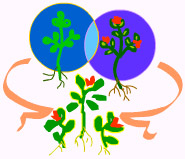
traditional terms, hybridization refers to the union of the male and the female
gamete to produce a zygote. In plant science, hybridization also refers to the
crossing or mating of two plants. The story of scientific hybridization of crop
plants started with J G Kolreuter, who in 1761 published his work on the
scientific bases of hybridization. Since then, hybridization followed by
selection, has been the major tool of plant breeding.
In
his quest to find more variability, man started experimenting with hybridization
of plants so as to achieve the perfect plant type. This process was actually the
beginning of expedited evolution since it led to the formation of new plant
types artificially or due to human intervention at a much faster pace than it
would have happened in nature. For example, the bread wheat that we eat today
has taken about 500 years to evolve to its present form through human
intervention. This form of wheat would have taken thousands of years to evolve
had it been left to the natural evolution process.
Ways in
which hybridization is used
Some of the ways in
which hybridization has been exploited in breeding crop plants are given below
 Combination
breeding: The main aim of combination breeding is to transfer one or
more characters into a single variety or plant type from many others. For this,
an existing plant variety may be used as the recipient parent while many other
crop varieties or wild relatives may contribute as donor parents. The most
commonly used method to achieve this goal is known as the backcross method. The
plant type in which the character or the trait is being transferred is known as
the recipient parent and the other as the donor parent. For this, the two plants
are mated or crossed and the progeny is screened for the desired trait. The
progeny plants possessing the desired trait are then selected and crossed back
to the recipient parent. This process is repeated until the desired plant type
having all the characteristics of the recipient in addition to the trait being
transferred is finally obtained. This exercise is known as backcrossing.
Backcrossing involves both hybridization and selection. Combination
breeding: The main aim of combination breeding is to transfer one or
more characters into a single variety or plant type from many others. For this,
an existing plant variety may be used as the recipient parent while many other
crop varieties or wild relatives may contribute as donor parents. The most
commonly used method to achieve this goal is known as the backcross method. The
plant type in which the character or the trait is being transferred is known as
the recipient parent and the other as the donor parent. For this, the two plants
are mated or crossed and the progeny is screened for the desired trait. The
progeny plants possessing the desired trait are then selected and crossed back
to the recipient parent. This process is repeated until the desired plant type
having all the characteristics of the recipient in addition to the trait being
transferred is finally obtained. This exercise is known as backcrossing.
Backcrossing involves both hybridization and selection.
Hybrid
varieties: Plant scientists exploit the characteristic feature of
better yielding �hybrids� in plants. Hybrid vigour, or hetrosis as it is
scientifically known, exploits the fact that some offspring from the progeny of
a cross between two known parents would be better than the parents themselves.
Many hybrid varieties of several crop species are being grown all over the world
today. An example of this is the hybrid tomatoes that we eat commonly. The
philosophy of hybridization has been extended from �within the same species or
genera (the same type of plants)� to �different species or genera (totally
different plants)�. This is known as wide or distant hybridization. Wide
hybridization has helped breeders to break what is known as the species or
genera barrier for gene transfer, i.e. it has helped breeders to transfer
beneficial characteristics from wild and weedy plants to the cultivated crop
species.
|