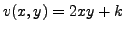
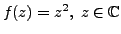
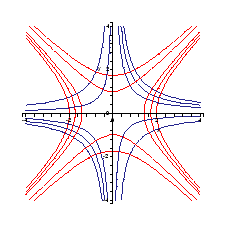
Harmonic functions
Definition 3.4.1
Let

be a function of two real variables

and

, defined over a domain

. Suppose that
has second order partial derivatives on
. The function
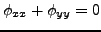
is called an harmonic function if it verifies
the equation:
Example 3.4.2
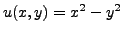
Take
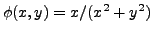
. Then over

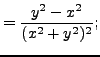
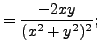
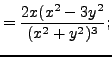
we have:
It follows that
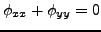
over
, i.e.
is harmonic
.
Now suppose that
 is analytic in a neighborhood
 of
of
 . Moreover suppose that the partial derivatives of
 and
and
 are differentiable and that the second partial derivatives are continuous
functions on
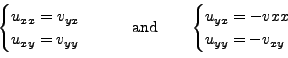
. From Cauchy-Riemann equations follows:
are differentiable and that the second partial derivatives are continuous
functions on
. From Cauchy-Riemann equations follows:
As the second partial derivatives are continuous on
, we have
 and
and
 . It follows that:
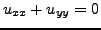 and
and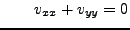 |
|
The computations that we performed before Definition
4.1
can be summarized in a theorem:
Theorem
3.4.3
If
is a function of a complex variable, analytic over a domain
 , then
and
are harmonic over
.
, then
and
are harmonic over
.
Example 3.4.4
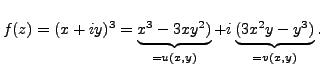
Let

. The function is an entire function, as we proved previously. With

and

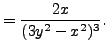
, we have:
On the one hand, e have:
On the other hand, we have:
The functions
and
are both harmonic.
Definition 3.4.5
Let
be a function of two real variables, harmonic over a domain
. Let
be a function of two real variables, defined over
, and such that
is analytic over
. Then
is called an harmonic conjugate of
.
We can now discover another important property of the analytic conjugates.
Theorem 3.4.7
Let
 , as usual.
Suppose that , as usual.
Suppose that
 is analytic over some domain
 . Then the level curves of
are orthogonal to the level curves of
.
. Then the level curves of
are orthogonal to the level curves of
.
Proof. Use Cauchy-Riemann equations and show that the gradients of
and
are orthogonal, whence the result.

|