Polar form.
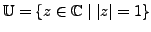
We denote by
 the set of all complex numbers whose absolute value is equal to 1.
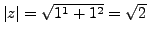
For example,
 and
and
 , but
, but
 .
.
The image of
in the Cauchy-Argand plane is the unit circle: if
 , with real
 , then
 if,
and only if if,
and only if
 .
.
Proposition 1.3.1
Let
; then
 exists and is an element of
.
exists and is an element of
.
We leave the proof to the reader; use Corollary 1.18.
Proposition 1.3.2
For any
 and
and
 , we have
 .
.
Proof. For any
and
, we have:
whence
.

And now we will see how complex numbers are tied with trigonometry.
Theorem 1.3.3
Let
.
There exists a real number
 such that
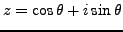 .
.
Proof. Denote
, where

and

are real numbers. Then
if,
and only if,
, i.e. the image of

in the complex plane is a point on the unit-circle. For each point on the
unit-circle, there exist a real number
such that the coordinates of this point are

, whence the result.
Definition 1.3.4
The number
is called an argument of
and is denoted

.
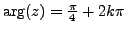
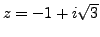
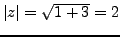
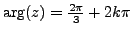
Note that this argument is defined up to an additional
 .
.
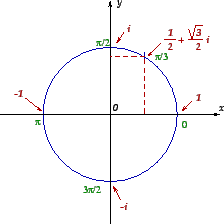
In Fig 5,
a value of the argument of the complex number corresponding to a point is
diplayed in green.
Figure 5: The unit circle in
Cauchy-Argand plane.
 |
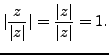
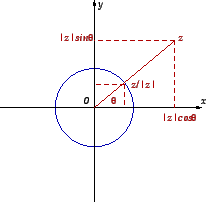
We can now generalize this to any non zero complex number. First note that
for any
 , we have
 , as the following holds:
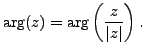
Definition 1.3.6
For any
,
Figure 6: The trigonometric
form of a non zero complex number.
 |
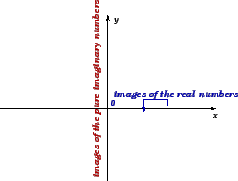
The following proposition is easy to understand. It explains the specific
role of the coordinate axes when representing complex numbers in the
Cauchy-Argand plane.
Figure 7: Particular cases.
 |
Proof. Let
; denote

. Then:
(i)
 .
.
(ii)
Please do it yourself.
|