OneStopGate.Com
OnestopGate   OnestopGate

  JOIN GATE GROUP, Looking for GATE Preparation Materials? Join & Get GATE Preparation Materials now!, JOIN GATE GROUP
OnestopGate
Home | Overview | Syllabus | Tutorials | FAQs | Downloads | Advertise | Contact Us | Forum
OneStopGate

GATE Overview
  arrow to indicate  Overview
  arrow to indicate  GATE Eligibility
  arrow to indicate  Structure Of GATE
  arrow to indicate  GATE Coaching       Centers
  arrow to indicate  Colleges Providing M.Tech/M.E.
  arrow to indicate  GATE Score
  arrow to indicate  GATE Results
  arrow to indicate  PG with Scholarships
  arrow to indicate  Article On GATE
  arrow to indicate  GATE Forum

GATE 2009 Exclusive
  arrow to indicate  GATE 2009 Syllabus
  arrow to indicate  GATE Organizing Institute
  arrow to indicate  Important Dates
  arrow to indicate  How to Apply
  arrow to indicate  Discipline Codes

GATE Syllabus
  arrow to indicate  Aerospace Engg..
  arrow to indicate  Agricultural Engg..
  arrow to indicate  Architecture and Planning
  arrow to indicate  Chemical Engg..
  arrow to indicate  Chemistry
  arrow to indicate  Civil Engg..
  arrow to indicate  Computer Science / IT
  arrow to indicate  Electronics & Communication Engg..
  arrow to indicate  Electrical Engg..
  arrow to indicate  Engineering Sciences
  arrow to indicate  Geology and Geophysics
  arrow to indicate  Instrumentation Engineering
  arrow to indicate  Life Sciences
  arrow to indicate  Mathematics
  arrow to indicate  Mechanical Engg..
  arrow to indicate  Metallurgical Engg..
  arrow to indicate  Mining Engg..
  arrow to indicate  Physics
  arrow to indicate  Production & Industrial Engg..
  arrow to indicate  Pharmaceutical Sciences
  arrow to indicate  Textile Engineering and Fibre Science

GATE Study Material
  arrow to indicate  Aerospace Engg..
  arrow to indicate  Agricultural Engg..
  arrow to indicate  Chemical Engg..
  arrow to indicate  Chemistry
  arrow to indicate  Civil Engg..
  arrow to indicate  Computer Science /       IT
  arrow to indicate  Electronics &       Communication Engg..
  arrow to indicate  Electrical Engg..
  arrow to indicate  Engineering Sciences
  arrow to indicate  Instrumentation       Engg..
  arrow to indicate  Life Sciences
  arrow to indicate  Mathematics
  arrow to indicate  Mechanical Engg..
  arrow to indicate  Physics
  arrow to indicate  Pharmaceutical       Sciences
  arrow to indicate  Textile Engineering        and Fibre Science

GATE Preparation
  arrow to indicate  GATE Pattern
  arrow to indicate  GATE Tips N Tricks
  arrow to indicate  Compare Evaluation
  arrow to indicate  Sample Papers
  arrow to indicate  GATE Downloads
  arrow to indicate  Experts View

CEED 2009
  arrow to indicate  CEED Exams
  arrow to indicate  Eligibility
  arrow to indicate  Application Forms
  arrow to indicate  Important Dates
  arrow to indicate  Contact Address
  arrow to indicate  Examination Centres
  arrow to indicate  CEED Sample Papers

Discuss GATE
  arrow to indicate  GATE Forum
  arrow to indicate  Exam Cities
  arrow to indicate  Contact Details
  arrow to indicate  Bank Details

Miscellaneous
  arrow to indicate  GATE FAQs
  arrow to indicate  Advertisment
  arrow to indicate  Contact Us

Home » Gate Study Material » Mathematics » Linear Algebra » Introduction and Basic Operations

Introduction and Basic Operations

Looking for GATE Preparation Material? Join & Get here now!
Discussion Center

Discuss/
Query

Papers/
Syllabus

Feedback/Suggestion

Yahoo
Groups

Sirfdosti
Groups

Contact
Us
  Print
Introduction and Basic Operations

Matrices, though they may appear weird objects at first, are a very important tool in expressing and discussing problems which arise from real life cases.

Our first example deals with economics. Indeed, consider two families A and B (though we may easily take more than two). Every month, the two families have expenses such as: utilities, health, entertainment, food, etc... Let us restrict ourselves to: food, utilities, and health. How would one represent the data collected? Many ways are available but one of them has an advantage of combining the data so that it is easy to manipulate them. Indeed, we will write the data as follows:


\begin{displaymath}\mbox{Month}=\left(\begin{array}{cccc}
\mbox{Family}&\mbox{Fo...
...ies}&\mbox{Health} \\
A&a&b&c\\
B&d&e&f\\
\end{array}\right)\end{displaymath}


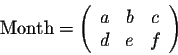
If we have no problem confusing the names and what the expenses are, then we may write


\begin{displaymath}\mbox{Month}=\left(\begin{array}{cccc}
a&b&c\\
d&e&f\\
\end{array}\right)\end{displaymath}


This is what we call a Matrix. The size of the matrix, as a block, is defined by the number of Rows and the number of Columns. In this case, the above matrix has 2 rows and 3 columns. You may easily come up with a matrix which has m rows and n columns. In this case, we say that the matrix is a (mxn) matrix (pronounce m-by-n matrix). Keep in mind that the first entry (meaning m) is the number of rows while the second entry (n) is the number of columns. Our above matrix is a (2x3) matrix.

When the numbers of rows and columns are equal, we call the matrix a square matrix. A square matrix of order n, is a (nxn) matrix.

Back to our example, let us assume, for example, that the matrices for the months of January, February, and March are


\begin{displaymath}J=\left(\begin{array}{cccc}
600&250&350\\
550&180&400\\
\en...
...0\\
625&350&410\\
\end{array}\right)\;,\;\mbox{respectively}.\end{displaymath}


To make sure that the reader knows what these numbers mean, you should be able to give the Health-expenses for family A and Food-expenses for family B during the month of February. The answers are 250 and 600. The next question may sound easy to answer, but requires a new concept in the matrix context. Indeed, what is the matrix-expense for the two families for the first quarter? The idea is to add the three matrices above. It is easy to determine the total expenses for each family and each item, then the answer is


\begin{displaymath}\mbox{First Quarter}=\left(\begin{array}{cccc}
1830&850&950\\
1775&800&1210\\
\end{array}\right)\end{displaymath}


So how do we add matrices? An approach is given by the above example. The answer is to add entries one by one. For example, we have


\begin{displaymath}\left(\begin{array}{cccc}
a&b&c\\
d&e&f\\
\end{array}\right...
...c+ \gamma\\
d + \theta&e + \nu&f + \mu \\
\end{array}\right).\end{displaymath}


Clearly, if you want to double a matrix, it is enough to add the matrix to itself. So we have


\begin{displaymath}\mbox{double of} \left(\begin{array}{cccc}
a&b&c\\
d&e&f\\
...
...;\left(\begin{array}{cccc}
a&b&c\\
d&e&f\\
\end{array}\right)\end{displaymath}


which implies


\begin{displaymath}\left(\begin{array}{cccc}
a&b&c\\
d&e&f\\
\end{array}\right...
...\begin{array}{cccc}
2a&2b&2c\\
2d&2e&2f\\
\end{array}\right).\end{displaymath}


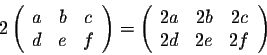
This suggests the following rule


\begin{displaymath}2 \left(\begin{array}{cccc}
a&b&c\\
d&e&f\\
\end{array}\rig...
...(\begin{array}{cccc}
2a&2b&2c\\
2d&2e&2f\\
\end{array}\right)\end{displaymath}


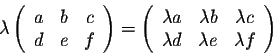
and for any number $\lambda$, we will have


\begin{displaymath}\lambda \left(\begin{array}{cccc}
a&b&c\\
d&e&f\\
\end{arra...
...lambda c\\
\lambda d&\lambda e&\lambda f\\
\end{array}\right)\end{displaymath}


Let us summarize these two rules about matrices.


Addition of Matrices: In order to add two matrices, we add the entries one by one.
Note: Matrices involved in the addition operation must have the same size.
 
Multiplication of a Matrix by a Number: In order to multiply a matrix by a number, you multiply every entry by the given number.

Keep in mind that we always write numbers to the left and matrices to the right (in the case of multiplication).

What about subtracting two matrices? It is easy, since subtraction is a combination of the two above rules. Indeed, if M and N are two matrices, then we will write


M-N = M + (-1)N


So first, you multiply the matrix N by -1, and then add the result to the matrix M.

Example. Consider the three matrices J, F, and M from above. Evaluate


\begin{displaymath}J + 2 F\;, \; J-M\;, \; \mbox{and} \; J-F+2M.\end{displaymath}


Answer. We have


\begin{displaymath}J + 2 F = \left(\begin{array}{cccc}
600&250&350\\
550&180&40...
...{array}{cccc}
650&330&250\\
600&270&400\\
\end{array}\right) \end{displaymath}


and since


\begin{displaymath}2 \left(\begin{array}{cccc}
650&330&250\\
600&270&400\\
\en...
...rray}{cccc}
1300&660&500\\
1200&540&800\\
\end{array}\right) \end{displaymath}


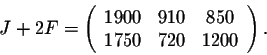
we get


\begin{displaymath}J + 2 F = \left(\begin{array}{cccc}
1900&910&850\\
1750&720&1200\\
\end{array}\right).\end{displaymath}


To compute J-M, we note first that


\begin{displaymath}(-1)M = \left(\begin{array}{cccc}
-580&-270&-350\\
-625&-350&-410\\
\end{array}\right)\;.\end{displaymath}


Since J-M = J + (-1)M, we get


\begin{displaymath}J-M = \left(\begin{array}{cccc}
600&250&350\\
550&180&400\\ ...
...gin{array}{rrrr}
20&-20&0\\
-75&-170&-10\\
\end{array}\right)\end{displaymath}


And finally, for J-F+2M, we have a choice. Here we would like to emphasize the fact that addition of matrices may involve more than one matrix. In this case, you may perform the calculations in any order. This is called associativity of the operations. So first we will take care of -F and 2M to get


\begin{displaymath}-F = (-1)F=\left(\begin{array}{cccc}
-650&-330&-250\\
-600&-...
...ay}{cccc}
1160&540&700\\
1250&700&820\\
\end{array}\right)\;.\end{displaymath}


Since J-F+2M = J + (-1)F + 2M, we get


\begin{displaymath}J-F+2M = \left(\begin{array}{cccc}
600&250&350\\
550&180&400...
...rray}{cccc}
1160&540&700\\
1250&700&820\\
\end{array}\right).\end{displaymath}


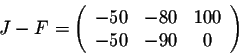
So first we will evaluate J-F to get


\begin{displaymath}J-F = \left(\begin{array}{cccc}
-50&-80&100\\
-50&-90&0\\
\end{array}\right)\end{displaymath}


to which we add 2M, to finally obtain


\begin{displaymath}J-F + 2M = \left(\begin{array}{cccc}
-50&-80&100\\
-50&-90&0...
...rray}{cccc}
1110&460&800\\
1200&610&820\\
\end{array}\right).\end{displaymath}


For the addition of matrices, one special matrix plays a role similar to the number zero. Indeed, if we consider the matrix with all its entries equal to 0, then it is easy to check that this matrix has behavior similar to the number zero. For example, we have


\begin{displaymath}\left(\begin{array}{ccc}
a&b&c\\
d&e&f\\
\end{array}\right)...
...= \left(\begin{array}{ccc}
a&b&c\\
d&e&f\\
\end{array}\right)\end{displaymath}


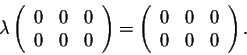
and


\begin{displaymath}\lambda \left(\begin{array}{ccc}
0&0&0\\
0&0&0\\
\end{array...
... \left(\begin{array}{ccc}
0&0&0\\
0&0&0\\
\end{array}\right).\end{displaymath}


What about multiplying two matrices? Such operation exists but the calculations involved are complicated.

MEMBERS LOGIN
  
EmailId:
Password:

  Forgot Password?
 New User? Register!
A D V E R T I S E M E N T
INTERVIEW EBOOK
Get 9,000+ Interview Questions & Answers in an eBook. Interview Question & Answer Guide
  • 9,000+ Interview Questions
  • All Questions Answered
  • 5 FREE Bonuses
  • Free Upgrades
START YOUR WEBSITE
India's Best Web Hosting Company
GATE RESOURCES
 
  • Gate Books
  • Training Institutes
  • Gate FAQs
  • GATE Exam, Gate 2009, Gate Papers, Gate Preparation & Related Pages


    GATE Overview | GATE Eligibility | Structure Of GATE | GATE Training Institutes | Colleges Providing M.Tech/M.E. | GATE Score | GATE Results | PG with Scholarships | Article On GATE | GATE Forum | GATE 2009 Exclusive | GATE 2009 Syllabus | GATE Organizing Institute | Important Dates for GATE Exam | How to Apply for GATE | Discipline / Branch Codes | GATE Syllabus for Aerospace Engineering | GATE Syllabus for Agricultural Engineering | GATE Syllabus for Architecture and Planning | GATE Syllabus for Chemical Engineering | GATE Syllabus for Chemistry | GATE Syllabus for Civil Engineering | GATE Syllabus for Computer Science / IT | GATE Syllabus for Electronics and Communication Engineering | GATE Syllabus for Engineering Sciences | GATE Syllabus for Geology and Geophysics | GATE Syllabus for Instrumentation Engineering | GATE Syllabus for Life Sciences | GATE Syllabus for Mathematics | GATE Syllabus for Mechanical Engineering | GATE Syllabus for Metallurgical Engineering | GATE Syllabus for Mining Engineering | GATE Syllabus for Physics | GATE Syllabus for Production and Industrial Engineering | GATE Syllabus for Pharmaceutical Sciences | GATE Syllabus for Textile Engineering and Fibre Science | GATE Preparation | GATE Pattern | GATE Tips & Tricks | GATE Compare Evaluation | GATE Sample Papers | GATE Downloads | Experts View on GATE | CEED 2009 | CEED 2009 Exam | Eligibility for CEED Exam | Application forms of CEED Exam | Important Dates of CEED Exam | Contact Address for CEED Exam | CEED Examination Centres | CEED Sample Papers | Discuss GATE | GATE Forum of OneStopGATE.com | GATE Exam Cities | Contact Details for GATE | Bank Details for GATE | GATE Miscellaneous Info | GATE FAQs | Advertisement on GATE | Contact Us on OneStopGATE |
    Copyright © 2009. One Stop Gate.com. All rights reserved Privacy Policies | About Us
    Our Portals : Academic Tutorials | Best eBooksworld | Beyond Stats | City Details | Interview Questions | Discussions World | Excellent Mobiles | Free Bangalore | Give Me The Code | Gog Logo | Indian Free Ads | Jobs Assist | New Interview Questions | One Stop FAQs | One Stop GATE | One Stop GRE | One Stop IAS | One Stop MBA | One Stop SAP | One Stop Testing | Quick2Host | Quick2Host Mirror | Quick Site Kit | Sirf Dosti | Source Codes World | Tasty Food | Tech Archive | Testing Interview Questions | Tests World | The Galz | Top Masala | Vyom | Vyom eBooks | Vyom International | Vyom Links | Vyoms | Vyom World
    C Interview Questions | C++ Interview Questions | Send Free SMS | Placement Papers | SMS Jokes